

EcoStruxure Software-Defined Automation
The biggest shift in industrial automation since the PLC was invented. Not an evolution — a fundamental rethink of how control systems are built, deployed, and managed.
What Is Software-Defined Automation?
Software-Defined Automation (SDA) is an architectural paradigm that completely separates automation software — the control logic, HMI applications, analytics, and AI models — from the specific hardware it runs on. In traditional industrial automation, the PLC is both the hardware and the software platform. The two are inseparable: your Siemens logic runs on Siemens hardware. Your Rockwell logic on Rockwell hardware. Your software is not yours — it is a configuration file that only works with one vendor's products.
SDA breaks this coupling. Control logic is written as portable software applications — using open standards such as IEC 61499 — that can run on any certified runtime environment. The hardware becomes infrastructure: interchangeable, upgradeable, and sourced independently of the software. Think of it the way modern IT separated operating systems from hardware, and cloud computing separated applications from physical servers. SDA brings that same abstraction to the factory floor and process plant.
Schneider Electric calls their implementation EcoStruxure Automation Expert — the world's first IEC 61499-based, hardware-agnostic automation platform purpose-built for industrial control. It is not a software layer bolted onto an existing PLC. It is a ground-up rethink of how automation engineering works.
The Problem With Traditional PLC-Based Automation
The Programmable Logic Controller was invented in 1968 to replace relay logic panels. It was a brilliant solution for its time — deterministic, reliable, real-time. The problem is that the fundamental architecture has barely changed in 55 years, while everything around it has transformed beyond recognition. Today's PLC-based DCS and control systems carry the weight of decades of proprietary decisions:
Vendor lock-in that compounds over decades
Every engineering hour invested in a proprietary automation platform makes it harder and more expensive to change. Plants running 25-year-old DCS systems face multi-million dollar replacements — not because the process has changed, but because the hardware reached end-of-life.
Hardware upgrade cycles that disrupt operations
A PLC CPU upgrade or I/O expansion requires engineering work, FAT, SAT, and often a plant shutdown. In an SDA architecture, adding compute capacity or new control applications is a software deployment — done remotely, without touching the plant.
Isolated systems that cannot share intelligence
A traditional DCS talks to itself. Connecting it to an MES, an ERP, a predictive maintenance platform, or a digital twin requires middleware, historians, and constant integration maintenance. SDA natively integrates these layers.
Slow innovation cycles locked to hardware roadmaps
Your automation capabilities are determined by your vendor's hardware development schedule. In SDA, new capabilities — an improved control algorithm, an AI-based optimiser, a new HMI — are software updates deployed instantly across every plant in your fleet.
“The average industrial plant spends 60–80% of its automation budget on maintaining and integrating existing systems — leaving only 20–40% for innovation and new capability. Software-Defined Automation inverts this ratio.”
— Schneider Electric, EcoStruxure SDA positioning
SDA vs. Traditional PLC Automation — Head to Head
| Dimension | Traditional PLC / DCS | EcoStruxure Software-Defined Automation |
|---|---|---|
| Hardware dependency | Logic is locked to the hardware it was programmed for. Changing the PLC brand or model means rewriting and re-certifying the application from scratch. | Logic is hardware-agnostic. The same application runs on any certified SDA runtime — whether on a Schneider Edge Box, an industrial PC, or a virtualised environment. |
| Vendor lock-in | Every vendor uses proprietary engineering tools, runtime environments, and communication stacks. Once you choose a PLC vendor, you are committed to their entire ecosystem. | Built on open standards — IEC 61499, OPC-UA, and MQTT. Your application is portable. You own your automation software as an asset, not as a configuration file tied to a specific hardware SKU. |
| Programming model | IEC 61131-3 (Ladder, FBD, ST, SFC) — well established, but inherently scan-cycle based and hardware-centric. Designed in the 1970s for the hardware constraints of that era. | IEC 61499 function blocks — event-driven, distributed, and object-oriented. Logic is modular, reusable across projects, and designed for distribution across multiple physical or virtual nodes. |
| Upgrading & change management | Hardware upgrades require full project re-engineering. A firmware update can break existing logic. Change management is slow, expensive, and carries significant re-validation risk. | Updates are software deployments. Add new control functions, swap algorithms, or scale capacity without touching hardware. The same discipline as modern software DevOps — version control, continuous integration, staged rollout. |
| Scalability | Scaling up requires buying and installing more hardware — more racks, more I/O, more CPUs. Scaling down means stranded hardware investment. | Scale compute resources dynamically. Add virtual CPUs or additional edge nodes to meet processing demand. One unified engineering environment manages the entire distributed control system. |
| AI & advanced analytics | External — AI models live in a separate analytics layer and can only react to historical data, not influence real-time control directly. | Native — AI models, digital twins, and machine learning algorithms run as applications inside the same software-defined control environment, with direct access to real-time process data and control output. |
| IT/OT convergence | A hard boundary separates OT (PLCs, DCS) from IT (ERP, MES, cloud). Bridging them requires middleware, historians, and complex integration projects. | OT and IT share the same software architecture. Control applications run alongside analytics, digital twins, and enterprise connectivity — on the same hardware or in a cloud-connected edge environment. |
EcoStruxure Automation Expert — Schneider's Implementation
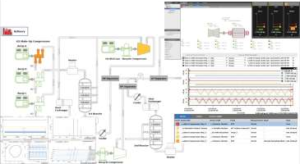
EcoStruxure Automation Expert (EAE) is Schneider Electric's SDA platform — the engineering environment, runtime, and application lifecycle manager that makes SDA real. It is built from the ground up around IEC 61499, the open international standard for distributed function block programming, and is designed to be hardware-agnostic from day one.
One Engineering Environment
A single tool configures the entire automation system — control logic, HMI, I/O mapping, network topology, and edge connectivity. Whether your system has 50 or 50,000 I/O points across 10 plants, EAE manages it from one interface. No separate PLC programming tool, HMI tool, and SCADA configuration tool.
Hardware Catalogue, Not Hardware Configuration
Instead of configuring specific hardware, engineers select from a hardware catalogue. Swap a hardware component in the catalogue — the application logic remains unchanged. Commission virtually first, then deploy to physical hardware. Simulation and virtual commissioning are native, not an afterthought.
Apps & Containers for Control Logic
Control logic is packaged as applications — modular, versioned, tested units that can be deployed, updated, and rolled back like any modern software. A pump control template used across 50 pumps in your plant is one application, deployed 50 times. Update the template once, propagate to all 50 instances in seconds.
Native AI & Digital Twin Integration
AI models and digital twin simulations run as native applications inside EAE — not as external analytics tools that receive data passively. An AI-based process optimiser can directly adjust setpoints in real-time, with the same determinism and safety guardrails as traditional control logic.
Open Standards Throughout
IEC 61499 control logic. OPC-UA for machine-to-machine communication. MQTT for cloud connectivity. REST APIs for enterprise integration. Every communication layer uses open, published standards — ensuring interoperability with third-party devices, platforms, and future systems not yet designed.
Fleet-Wide Deployment & Remote Management
Deploy the same validated application across multiple plants simultaneously. Update control logic across an entire fleet of compressor stations, wellheads, or production units — remotely, with version control, audit trail, and rollback capability. What once required a team of engineers on site for weeks is a managed software release.
Why Now? Why Will This Change Everything?
The idea of hardware-independent automation is not new — it has been discussed for 20 years. What has changed is that the conditions for mass adoption have finally converged.
Industry standards have caught up
IEC 61499 — the open standard enabling hardware-decoupled control logic — reached sufficient maturity for industrial deployment. NAMUR's Open Architecture (NOA) and the Open Process Automation Forum (OPAF) have produced interoperability standards now being piloted by major Oil & Gas operators including ExxonMobil, Shell, and Saudi Aramco.
Computing power has democratised
Ruggedised industrial edge computing hardware now delivers the processing power needed to run complex control logic in software — at a cost comparable to traditional PLCs. The constraint that made dedicated, single-purpose hardware necessary no longer exists.
The greenfield window is open
Every new plant, expansion, or major upgrade is a decision point. Specifying an SDA architecture today means avoiding a hardware upgrade cycle in 10 years. Engineering firms are already writing SDA into project specifications for major industrial projects.
The cost of vendor lock-in is becoming visible
As digital transformation accelerates, the inability to upgrade, integrate, or change automation systems without massive re-engineering costs is a strategic liability. Plant owners are quantifying this cost — and finding it justifies the transition to open architecture.
Workforce skills are shifting
A new generation of automation engineers is more comfortable writing Python and managing containerised applications than writing Ladder Logic. SDA brings automation engineering closer to modern software development practices, making it easier to attract and retain talent.
When Will SDA Reach the Process Industry?
The transition will not happen overnight — the industrial installed base is vast, and safety-critical applications carry validation and certification obligations that slow adoption. But the direction is unambiguous, and the pace is accelerating.
2020 – 2025
Pioneering
Open Process Automation Forum (OPAF) pilots at ExxonMobil, BASF, and Saudi Aramco. First greenfield SDA projects commissioned. Schneider EcoStruxure Automation Expert released and validated in production.
2025 – 2030
Early Majority
Greenfield process plants specify SDA as standard. Major EPCs train engineers in IEC 61499. Brownfield migration begins at first major plant turnarounds. SDA market growing 35–40% annually.
2030 – 2040
Mainstream
SDA becomes the default architecture for new automation projects globally. Traditional proprietary DCS confined to brownfield legacy maintenance. Hardware vendors compete on runtime performance, not software lock-in.
What this means for Egypt's process industry
Every major capital project in Egypt's Oil & Gas, power, and industrial sectors being planned today will be commissioned in the 2027–2032 window — precisely when SDA is entering mainstream specification. Projects specifying traditional proprietary DCS today are locking in an architecture that will be at a competitive disadvantage within its own operating lifetime. ASSET and Schneider Electric are positioned to help Egyptian operators and EPCs understand, evaluate, and specify SDA for projects where it delivers the highest long-term value.
Explore EcoStruxure Software-Defined Automation
Talk to ASSET about how SDA can be specified for your next project — and what it means for your existing automation infrastructure.